Why it was needed
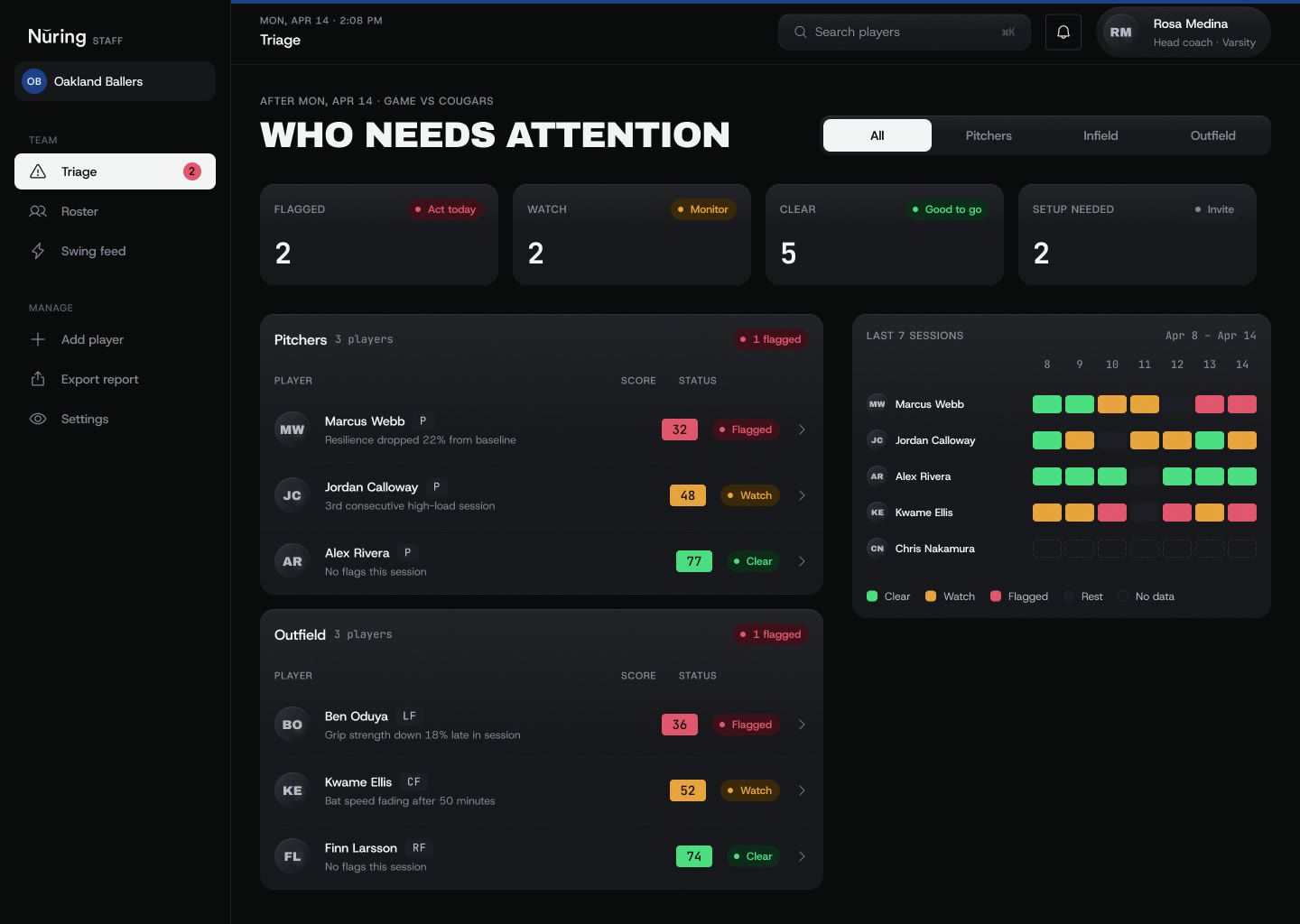
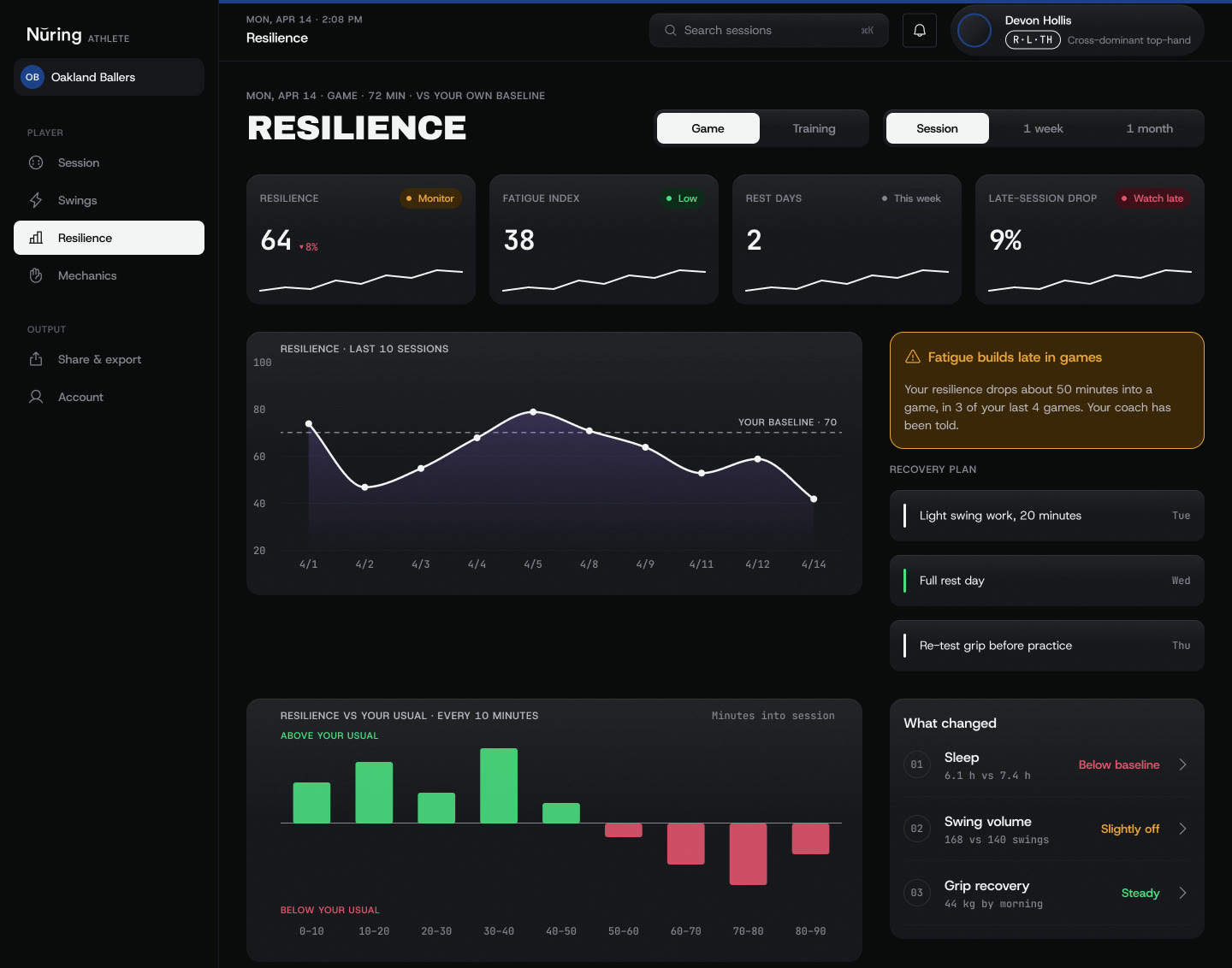
Nūring turns grip into data: effort, recovery and accumulated load, starting with baseball. The same numbers are read by an athlete mid-session, a coach deciding who needs attention, and a parent checking on their child. The system had to make dense data calm to read, and make sure a colour never means two different things.
How it's structured
Five variable collections: Primitives, Color, Space, Radius and Motion. Components only use semantic tokens, never raw values.
Primitives collection#0b0b0dPrimitives collection#4ade80color-bg-ground#0b0b0dcolor-status-good#4ade80App shell · backgroundcolor-bg-groundStatus pill / Goodcolor-status-goodThe Figma file runs from Foundations and Icons through Atoms (buttons, chips, form controls), Molecules (data display, navigation, rows, feedback) and Organisms (player card, app shell, tables, charts, session panels) to Templates.
Foundations
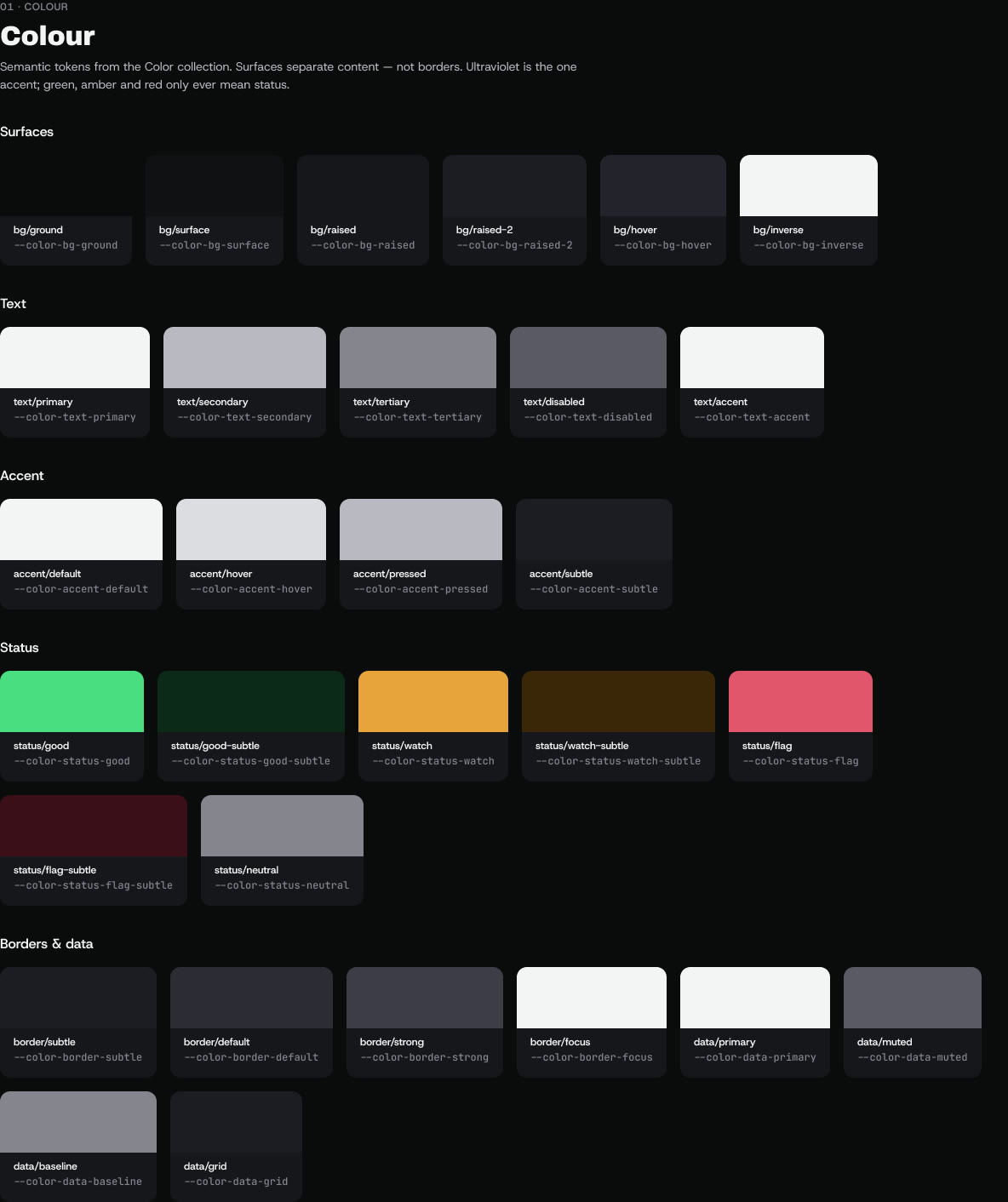
color-bg-ground#0b0b0dcolor-bg-surface#111114color-bg-raised#16161bcolor-bg-raised-2#1c1c22color-text-primary#f4f4f6color-text-secondary#b9b9c2color-status-good#4ade80color-status-watch#e8a33ccolor-status-flag#e2556ccolor-data-baseline#85858fcolor-border-default#2c2c35color-border-focus#f4f4f6Three typefaces, each with one job: Archivo Black for display and hero numbers, Host Grotesk for interface text, JetBrains Mono for tabular data. Space doubles at every step from 2 to 128, and radius nests: an inner element's radius is the outer radius minus the padding between them.
One scale for every score

This is the decision I'm proudest of. One scale means a coach reads "Watch" the same way on every screen, and an athlete is only ever compared with themselves.
Components in real screens
62 components, 25 icons and 14 full-page templates across four roles: athlete, staff, guardian and coach.
Documentation and governance
- Rules written into the file: depth comes from stacking surface tones; shadows are only for things that float (popovers, modals, the expanded player card).
- Names that travel: each Figma token shows its CSS name beside it, such as
bg/surface→--color-bg-surface. - Copy stored in natural case: the Label, Action and Code styles set capitals, so text isn't retyped when a style changes.
- Status is reserved: green, amber and red are never used for decoration, so they always mean something.